
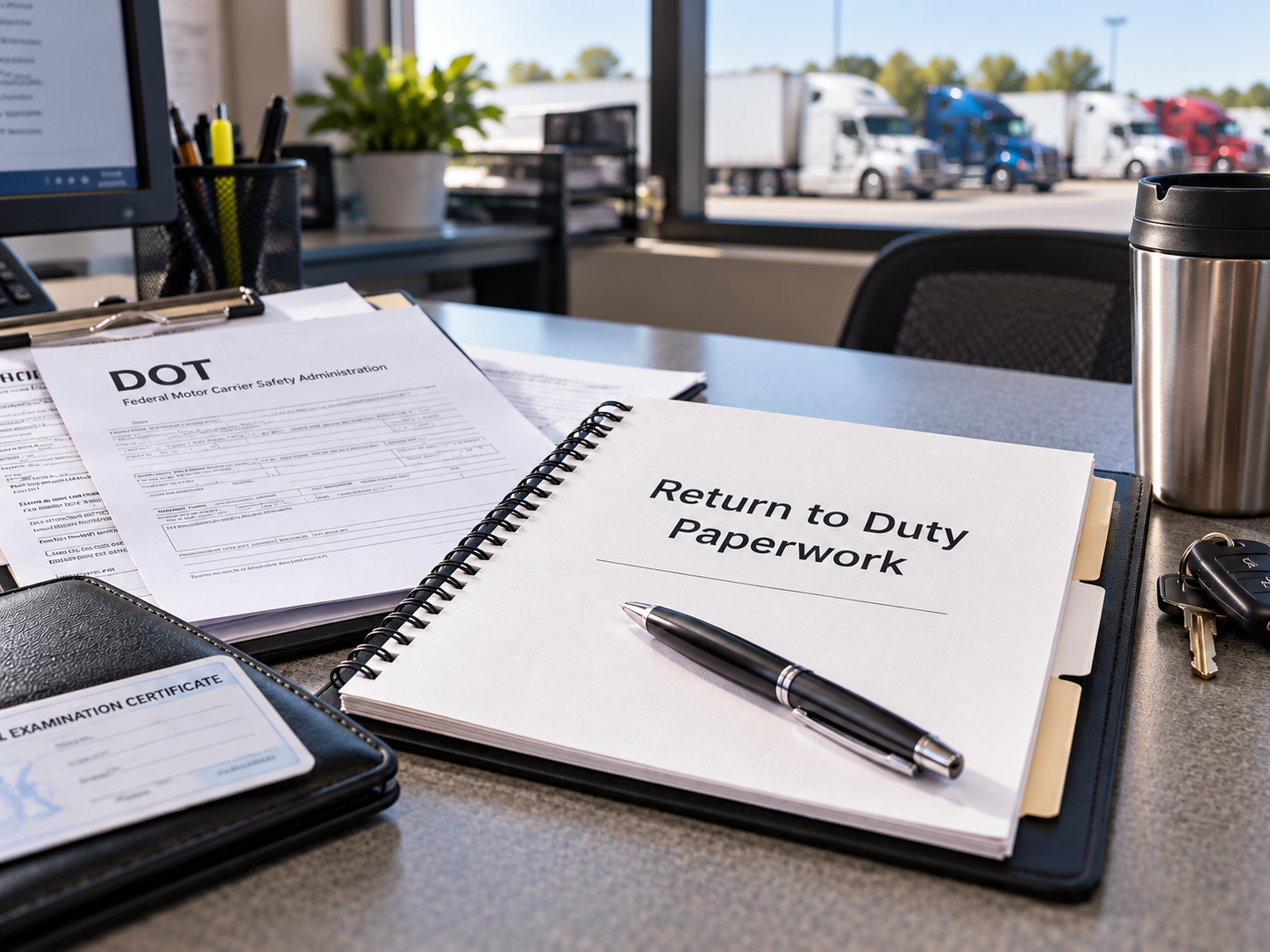
Return-to-Duty Process Basics
What Is the DOT Return-to-Duty Process?
A plain-English overview of the federally required process a safety-sensitive employee must complete after a DOT drug or alcohol violation before returning to safety-sensitive duties.
The DOT Return-to-Duty process is the sequence of steps a safety-sensitive employee must complete, under U.S. Department of Transportation rules, after a drug or alcohol regulation violation before they may return to performing safety-sensitive functions. The process is governed by 49 CFR Part 40, the DOT's procedural regulation for workplace drug and alcohol testing across all DOT agencies.
Who the process applies to
Part 40 applies to safety-sensitive employees regulated by DOT agencies, including commercial motor vehicle drivers covered by FMCSA, as well as employees regulated by the Federal Railroad Administration (FRA), Federal Transit Administration (FTA), Federal Aviation Administration (FAA), U.S. Coast Guard (USCG), and Pipeline and Hazardous Materials Safety Administration (PHMSA). If your job is safety-sensitive under any of these agencies, a DOT drug or alcohol violation triggers the Return-to-Duty process.
What triggers the process
The process is triggered by a verified positive drug test, an alcohol test result of 0.04 or greater, or a refusal to test. Under DOT rules, a refusal to test is treated as a violation and carries the same Return-to-Duty requirement as a positive test.
The role of the Substance Abuse Professional
A central figure in the process is the Substance Abuse Professional (SAP). The SAP is a qualified professional who evaluates the employee, recommends education and/or treatment, conducts a follow-up evaluation, prepares required reports, and establishes the follow-up testing plan. The SAP does not provide the education, treatment, or testing themselves, those are handled separately.
An overview of the steps
In broad terms, the process moves from removal from safety-sensitive duties, to an initial SAP evaluation and recommendation, to completion of any required education or treatment, to a follow-up SAP evaluation, to a Return-to-Duty test arranged by the employer, and finally to a follow-up testing plan after the employee returns to duty. Each of these steps is explained in more detail in the companion articles in this section.
Who decides whether you return to work
Completing the SAP process does not by itself guarantee a return to work. After the SAP determines that the employee has successfully complied with the recommendation, the employer decides whether to proceed with the Return-to-Duty test and whether to return the employee to safety-sensitive duties.
Sources
Regulatory statements in this article are based on current, publicly available U.S. DOT and FMCSA sources. Links open the official references in a new tab.
Educational disclaimer: This article provides general information about the DOT Return-to-Duty process for safety-sensitive employees. It is not legal, medical, or case-specific advice and does not replace individualized guidance from a qualified Substance Abuse Professional (SAP). Your specific requirements depend on your violation, your employer, and the DOT agency rules that apply to you.
Ready to take the next step?
- Select “START YOUR EVALUATION.”
- Choose your appointment and pay securely.
- Complete your intake online.
- Meet with your Willow Bend SAP to learn your next steps.